NAD+ IV Therapy: The Science Behind Cellular Energy
Longevity Membership Spotlight
NAD+ IV Therapy: What the Science Says About the Molecule Behind Cellular Energy
Few molecules have received as much attention in longevity science over the past decade as NAD+ — nicotinamide adenine dinucleotide. It’s a coenzyme found in every cell of your body, essential for energy production, DNA repair, and the activity of proteins called sirtuins that researchers like Harvard’s Dr. David Sinclair have spent careers studying. NAD+ levels decline naturally as we age — by some estimates, levels in certain tissues can drop by more than half between young adulthood and older age.
That decline has fueled enormous interest in ways to restore NAD+ levels, including oral precursors like NMN and NR, and — increasingly — NAD+ IV therapy, which Provena Care offers as part of our longevity membership. Here’s what the science actually supports, and what to know before considering it.
What Is NAD+, and Why Does It Matter?
NAD+ is involved in hundreds of metabolic reactions, but two roles get the most attention in longevity research:
- Energy production — NAD+ is essential to the mitochondrial processes that convert food into usable cellular energy (ATP). Without adequate NAD+, mitochondria become less efficient.
- Sirtuin activation — Sirtuins are a family of proteins involved in DNA repair, inflammation regulation, and cellular stress responses. They require NAD+ to function. Dr. David Sinclair’s research has focused heavily on sirtuins (particularly SIRT1) and their role in the “information theory of aging” — the idea that aging is partly driven by a loss of epigenetic information, and that maintaining robust NAD+ levels may help support the cellular machinery that preserves that information.
NAD+ Precursors vs. NAD+ IV Therapy
Most of the public conversation about NAD+ — including extensive research coverage from Dr. Rhonda Patrick, a biomedical scientist known for her deep dives into nutrition and aging research — has focused on oral precursors: NMN (nicotinamide mononucleotide) and NR (nicotinamide riboside). These are molecules the body can convert into NAD+ through several enzymatic steps.
NAD+ IV therapy is a different delivery method entirely. Rather than providing a precursor and relying on the body’s conversion pathways, an NAD+ infusion delivers the NAD+ molecule itself directly into the bloodstream, bypassing digestion. Proponents argue this allows for more direct and immediate availability of NAD+ to tissues, though it’s worth being clear that direct IV NAD+ research in humans is still a developing area compared to the substantial body of research on oral precursors.
What People Report Experiencing
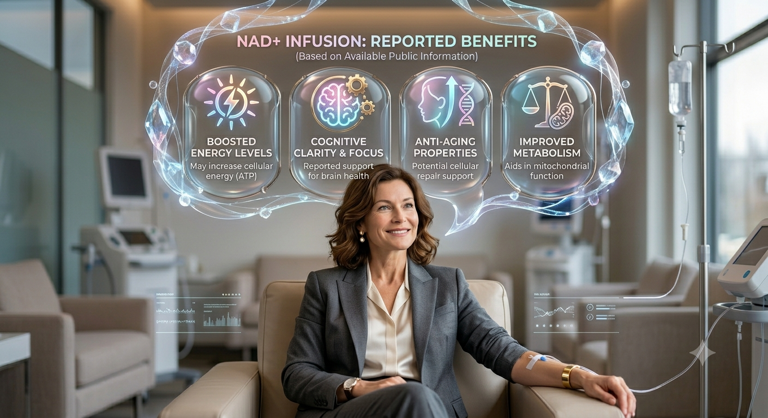
People who undergo NAD+ IV therapy commonly report:
- A sense of mental clarity or improved focus following infusions
- Increased energy levels in the hours and days afterward
- Improved sleep quality
- Some patients pursuing NAD+ therapy as part of recovery support protocols, including for fatigue
It’s important to frame these as commonly reported experiences rather than guaranteed outcomes — individual responses to NAD+ IV therapy vary, and the scientific literature on IV-specific delivery is still growing.
What Happens During an NAD+ Infusion at Provena Care
- A brief intake conversation with our care team to review your health history and goals
- Placement of an IV line, typically in the arm
- A slow infusion of NAD+ solution, which can take anywhere from 30 minutes to a few hours depending on the dose and your individual tolerance — some people experience sensations like flushing, chest tightness, or nausea if the infusion runs too quickly, which is why pacing matters
- Monitoring throughout the session by trained staff
How NAD+ IV Fits Into a Longevity Strategy
It’s worth being direct about something: no IV therapy, including NAD+, is a substitute for the foundational pillars of healthspan — exercise (particularly strength training and zone 2 cardio), sleep quality, nutrition, and stress management. NAD+ IV therapy is best understood as a complementary tool, not a replacement for those fundamentals.
That said, for patients who are already optimizing the fundamentals and are curious about additional support for energy, recovery, or cellular health, NAD+ IV therapy is one of the more requested services in our longevity membership — and one we’re happy to discuss honestly, including what the evidence does and doesn’t currently show.
Who Should Be Cautious
- People with certain cardiovascular conditions should discuss infusion rate and suitability with their provider
- Pregnant or breastfeeding individuals should avoid NAD+ IV therapy
- Anyone with a bleeding disorder or on blood thinners should discuss IV therapy generally with their provider
- People taking medications that affect NAD+ metabolism should mention this during intake
Frequently Asked Questions
How is NAD+ IV therapy different from taking NMN or NR supplements?
Oral precursors (NMN, NR) require the body to convert them into NAD+ through several steps and are absorbed through digestion. IV NAD+ delivers the molecule directly into the bloodstream. Both approaches are part of the broader NAD+ research landscape, but they are not interchangeable.
How often do people get NAD+ infusions?
This varies widely by individual and goals — some patients do periodic single sessions, while others incorporate them into a regular longevity protocol. Your care team can help determine a reasonable approach based on your goals and health history.
Is NAD+ IV therapy FDA-approved for anti-aging?
No. NAD+ IV therapy is not FDA-approved as an anti-aging treatment. It is offered as a wellness service, and we encourage patients to view it within that context — as a complementary option, not a medical treatment for any specific disease.
Does it hurt?
Most patients describe IV placement as a brief pinch, similar to any blood draw, and the infusion itself as generally comfortable, though some report sensations like flushing or warmth, especially if the infusion rate is faster.
Disclaimer: This article is for educational and informational purposes only and does not constitute medical advice, diagnosis, or treatment. NAD+ IV therapy is offered as a wellness service and is not FDA-approved for the treatment, cure, or prevention of any disease. Always discuss your full health history with a qualified healthcare provider before pursuing IV therapy.