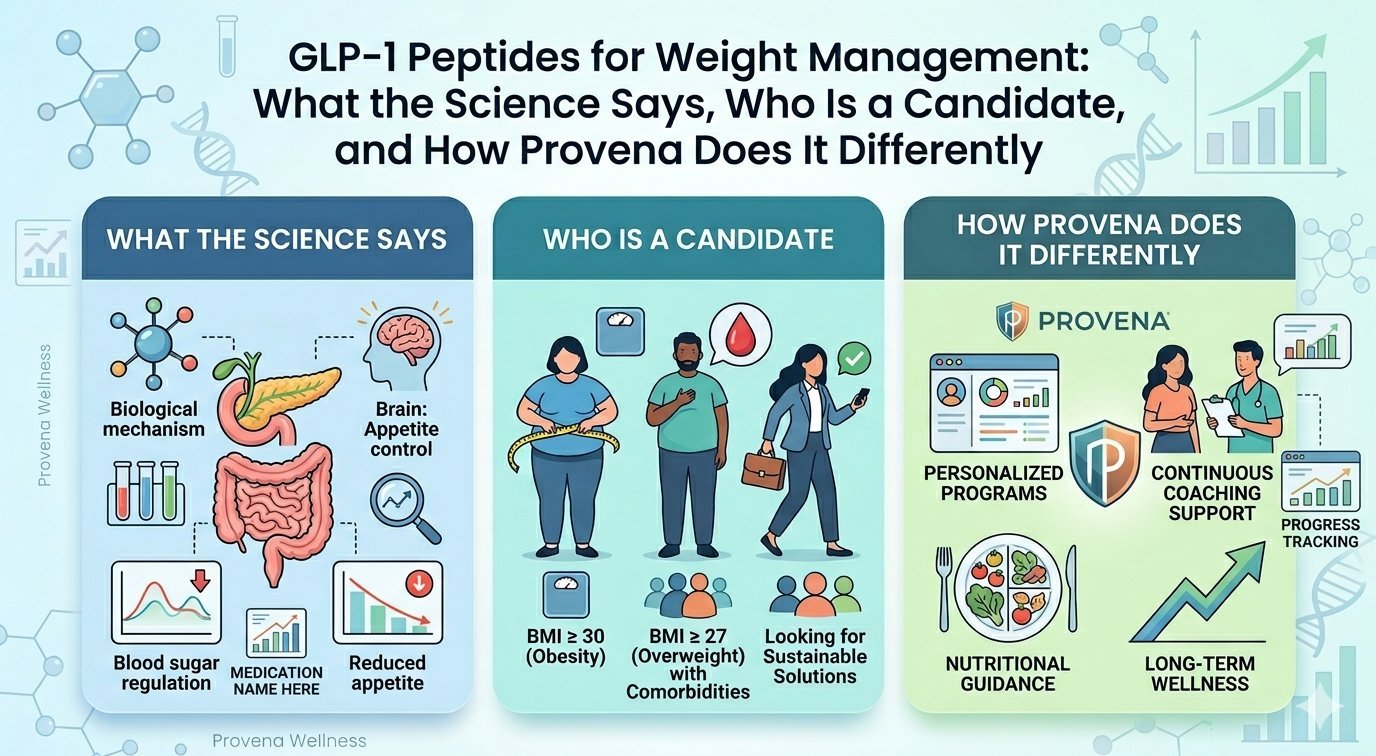
GLP-1 Peptides for Weight Management: What the Science Says, Who Is a Candidate, and How Provena Does It Differently
GLP-1 receptor agonists — semaglutide (Ozempic, Wegovy) and tirzepatide (Mounjaro, Zepbound) — have fundamentally changed the conversation around obesity and metabolic disease. The clinical results are genuinely impressive. But the explosion in demand has also created a chaotic prescribing landscape. This article explains what GLP-1 peptides actually do, what the evidence shows, and how Provena Care approaches GLP-1 therapy as a medically supervised protocol — not a subscription box.
By Aquiles Garcia-Menocal, APRN — Provena Care. Educational purposes only, not medical advice.
What the Clinical Evidence Shows
- STEP trials (semaglutide) — average weight loss of 14.9% of body weight over 68 weeks; subset lost more than 20%
- SURMOUNT trials (tirzepatide) — average weight loss up to 22.5% over 72 weeks, approaching bariatric surgery outcomes
- SELECT trial — semaglutide reduced major cardiovascular events by 20% in adults with obesity and established cardiovascular disease — establishing GLP-1s as a cardiovascular treatment, not just a weight loss tool
The Side Effect Profile
GI effects (nausea, vomiting, constipation) occur primarily during dose escalation and improve at stable dosing for most patients. More critically: muscle mass loss. Studies show 25–40% of weight lost on GLP-1 therapy can be lean mass without adequate protein and resistance training. This is the most underaddressed problem in GLP-1 prescribing. At Provena, every GLP-1 patient receives specific protein targets (1.0–1.2g per lb lean body mass) and resistance training guidance.
Who Is a Good Candidate
- BMI 30+ (obesity), or 27+ with at least one weight-related comorbidity
- Genuine prior attempts at lifestyle modification without sustained results
- Metabolic labs showing insulin resistance, elevated HbA1c, or metabolic dysfunction
- No contraindications: personal/family history of medullary thyroid cancer, MEN2, pancreatitis, or severe GI disease
- Commitment to dietary and exercise components that maximize results and minimize muscle loss
How Provena Care Approaches GLP-1 Differently
Before starting: comprehensive metabolic labs (fasting glucose, fasting insulin, HbA1c, ApoB, liver enzymes, thyroid), medical history, contraindication screening, baseline body composition. During: careful dose escalation monitoring, protein targets, resistance training integration, follow-up labs including body composition — not just scale weight. Discontinuation planning from day one: GLP-1 is a tool, not a permanent solution for everyone.