HMO, PPO or EPO? How Your 2027 Plan Type Affects Your Primary Care
Open Enrollment · Patient Guide
The short answer: an HMO usually asks you to choose a primary care provider and get referrals, and covers care only inside its network except for emergencies. A PPO lets you see doctors without a referral and covers some out-of-network care at a higher cost. An EPO sits in between: in-network only, with primary care and referral rules that vary by plan. Whichever plan type you choose for 2027, check that your primary care provider is in the network of the exact plan before you enroll.
Every fall, people in Miami-Dade pick a new health plan by comparing premiums and deductibles, then discover in January that their doctor is not in the network or that they need a referral to see a specialist. The plan type is what decides those rules. This guide explains HMO, EPO and PPO plans in plain language, so you can keep the care you want when you enroll in a Marketplace or Medicare Advantage plan.
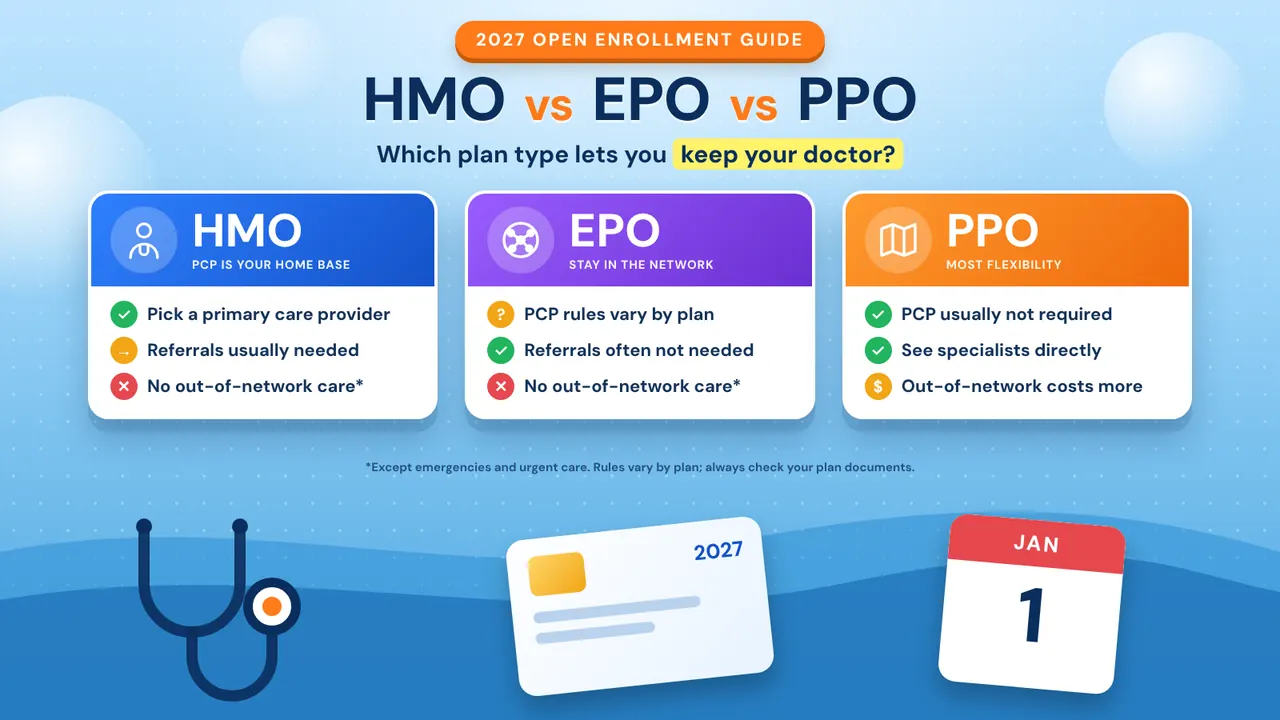
HMO vs PPO vs EPO: what is the difference for primary care?
General patterns only. Rules differ between plans, so always check the plan’s summary of benefits and provider directory.
HMO: a primary care provider at the center
A Health Maintenance Organization plan is built around a primary care provider. You pick one when you enroll, or the plan assigns one if you do not. That provider handles your everyday care and usually refers you when you need a specialist. Care outside the network is usually not covered, except for emergencies and, in some plans, urgent care. Some HMOs, called HMO-POS plans, allow limited out-of-network care. HMOs often have lower premiums, and they work best when you already have a primary care provider you trust inside the network.
EPO: in-network only, with fewer gatekeepers
An Exclusive Provider Organization plan also covers care only from its network, except emergencies. Many EPO plans let you see specialists without a referral, and some do not require you to name a primary care provider at all. Others do, so read the plan’s rules before assuming either way.
PPO: the most flexibility, usually at a higher price
A Preferred Provider Organization plan lets you see in-network doctors and specialists without referrals, and it still pays for some care outside the network, at a higher cost to you. That flexibility usually comes with higher premiums or deductibles. Even with a PPO, having a regular primary care provider makes it easier to keep your preventive care, medications and labs in one place.
HMO vs PPO in Medicare Advantage, and how Original Medicare differs
Most Medicare Advantage plans are HMOs or PPOs, and similar rules usually apply: an HMO usually asks you to choose a primary care provider and get referrals, while a PPO gives you more freedom at a higher cost out of network. Original Medicare works differently. It has no network and no referral requirement, so you can see any provider who accepts Medicare. Many people pair it with a Part D drug plan and a Medigap policy. Medicare open enrollment runs October 15 to December 7, and people already in a Medicare Advantage plan can make one change from January 1 to March 31.
How to keep your primary care provider when you enroll
- Search the directory for the exact plan. Carriers sell many plans with different networks, so a doctor can be in one plan from a carrier and not another. Search by the plan name, not just the insurance company.
- Call the office to confirm. Directories are not always current. A two-minute call to your primary care office confirms the plan and whether they are accepting new patients.
- Name your primary care provider during enrollment. If the plan asks for one, choose the provider as listed in that plan’s directory, so you are not assigned someone else.
- Check the referral rules. If you see specialists often, an HMO’s referral step matters more for you. Read how referrals work before you choose.
- Compare total costs, not only the premium. Look at the deductible, copays and out-of-pocket maximum, and check that your regular prescriptions are on the plan’s drug list.
- Book a visit once coverage starts. An early preventive visit (for Medicare, the annual wellness visit) puts your history, medications and labs on file with your primary care office from day one.
Key dates for 2027 coverage
- Medicare open enrollment: October 15 to December 7.
- ACA Marketplace open enrollment: starts November 1. Enroll by December 15 for coverage that starts January 1, and check HealthCare.gov for the final deadline.
- Medicare Advantage Open Enrollment: January 1 to March 31, for people already in a Medicare Advantage plan.
Frequently asked questions
Do I have to choose a primary care provider with an HMO?
Usually yes. Most HMO plans ask you to choose a primary care provider when you enroll, and many assign one if you do not choose. You can typically change your primary care provider later by contacting the plan.
Is an HMO or a PPO better?
Neither is better for everyone. An HMO often costs less and suits people who are happy coordinating care through one primary care provider. A PPO costs more but suits people who want to see specialists directly or use doctors outside the network. The right choice depends on your doctors, your health needs and your budget.
Can I see a doctor outside my network in an emergency?
Yes. Federal rules require Marketplace and Medicare Advantage plans to cover emergency services at any emergency room, without prior approval and at in-network cost sharing. Follow-up care after the emergency usually needs to happen in the network, so check your plan’s rules.
How do I know if my doctor is in a plan’s network?
Search the provider directory for the specific plan you are considering, then call the doctor’s office to confirm. Networks change from year to year, so check again even if you are keeping the same carrier.
What is a primary care provider (PCP)?
A primary care provider is the clinician you see for everyday care: checkups, sick visits, chronic conditions, prescriptions and preventive screening. Depending on the plan, a PCP can be a physician, a nurse practitioner (APRN) or a physician assistant.
Do I need a referral to see a specialist?
It depends on the plan type. Most HMOs require a referral from your primary care provider, many EPOs do not, and PPOs generally do not. Check your plan’s summary of benefits to be sure.
Can a nurse practitioner be my primary care provider?
Often, yes. In Florida, many plans list nurse practitioners (APRNs) as primary care providers. Search the plan’s directory to see which providers you can choose.
Can I change plans after open enrollment?
Usually only with a qualifying life event, such as moving or losing other coverage, which opens a special enrollment period. People already in a Medicare Advantage plan can also make one change from January 1 to March 31.
Can Provena Care tell me which plan to choose?
We can tell you whether we participate in a specific plan, but we cannot recommend a plan. For help comparing plans, use HealthCare.gov, Medicare.gov, 1-800-MEDICARE (TTY 1-877-486-2048) or a licensed insurance agent.
Check your 2027 plan with us
Provena Care is a primary care practice in Kendall that accepts many ACA Marketplace and Medicare Advantage plans. Aquiles Garcia-Menocal, APRN, is our primary care provider, with Dr. Victor Calvo, MD, as medical director, and our team speaks English and Spanish. Call (305) 395-7108 with the name of the plan you are considering and we will tell you whether we participate. See our open enrollment guide or the carriers we accept.
This article is general information about health plan types, not insurance or medical advice. Plan rules, networks and costs vary, so review each plan’s documents before you enroll. Provena Care does not sell insurance or recommend specific plans.